Sunday, 19 February 2017

Kawasaki H2 750 1972 Price, Colors, Specification

                             Kawasaki H2 750


Kawasaki H2 750 Price, Specs, Review, Top speed, Wikipedia, Color

                         Kawasaki’s 748cc two-stroke engine kicked out 74hhp and had more mid-range torque than its 500cc HI predecessor. Hydraulic steering damper was a worthwhile addition.

Kawasaki H2 750 HD Pics

                       Lean, simple styling gave little clue to the H2’s fearsome performance.

Kawasaki H2 750 HD Images HD Photos

                           High handlebars were a hindrance at high speed but no handicap to the Kawasaki's reputation as an unbeatable sprinter away from the traffic lights.

Kawasaki H2 750 HD Wallpaper

                            For sheer excitement, there was nothing gfiSS* on two wheels to match the 750 H2 two- stroke triple that Kawasaki unleashed in 1972. Fast, loud, smoky, thirsty and ill-handling, the bike that was also known as the Mach IV was a wild ride that quickly earned a reputation for unmatched speed and aggression. ‘It’s so quick it demands the razor-sharp reactions of an experienced rider,’ bragged Kawasaki’s publicity material, and few who rode the triple disagreed. 

Kawasaki H2 750 Exhaust Sound

                               The basis of the H2 was Kawasaki’s first three- cylinder two-stroke, the 500cc HI (or Mach III), which had been launched in 1969. This too was a fast and fiery machine that became popular, especially with American riders who valued acceleration from a standing start above all else. This group, labelled ‘stoplight-to-stoplight freaks’ by one magazine, was even better served by the larger model, whose 748cc air-cooled engine had a peak output of 74bhp at 6800rpm.

                          That was not only 14bhp up on the smaller triple, but also put rivals such as Suzuki’s liquid- cooled GT750 triple and Honda’s CB750 four in the shade. Physically the new model closely resembled the Mach III, with fairly high and wide handlebars and fuel tank that was narrow despite the compact three-cylinder engine’s thirst. The chassis layout of twin-downtube frame, twin rear shocks and slim forks holding a 19-inch front wheel and single brake disc also matched that of the smaller machine.

Searing acceleration

                                 As well as its extra capacity the H2 had milder porting and ignition timing, which helped give a usefully broad spread of power. But although that meant the triple could be ridden gently, with minimal use of its five-speed gearbox, that was not what this bike was built for. Sheer speed was its forte, not so much the maximum of about 120mph (193km/h) as the searing acceleration that enabled it to reach over 1 OOmph (161km/h) from a standing start in less than 13 seconds, and to leave the line in a cloud of smoke with its front wheel in the air.
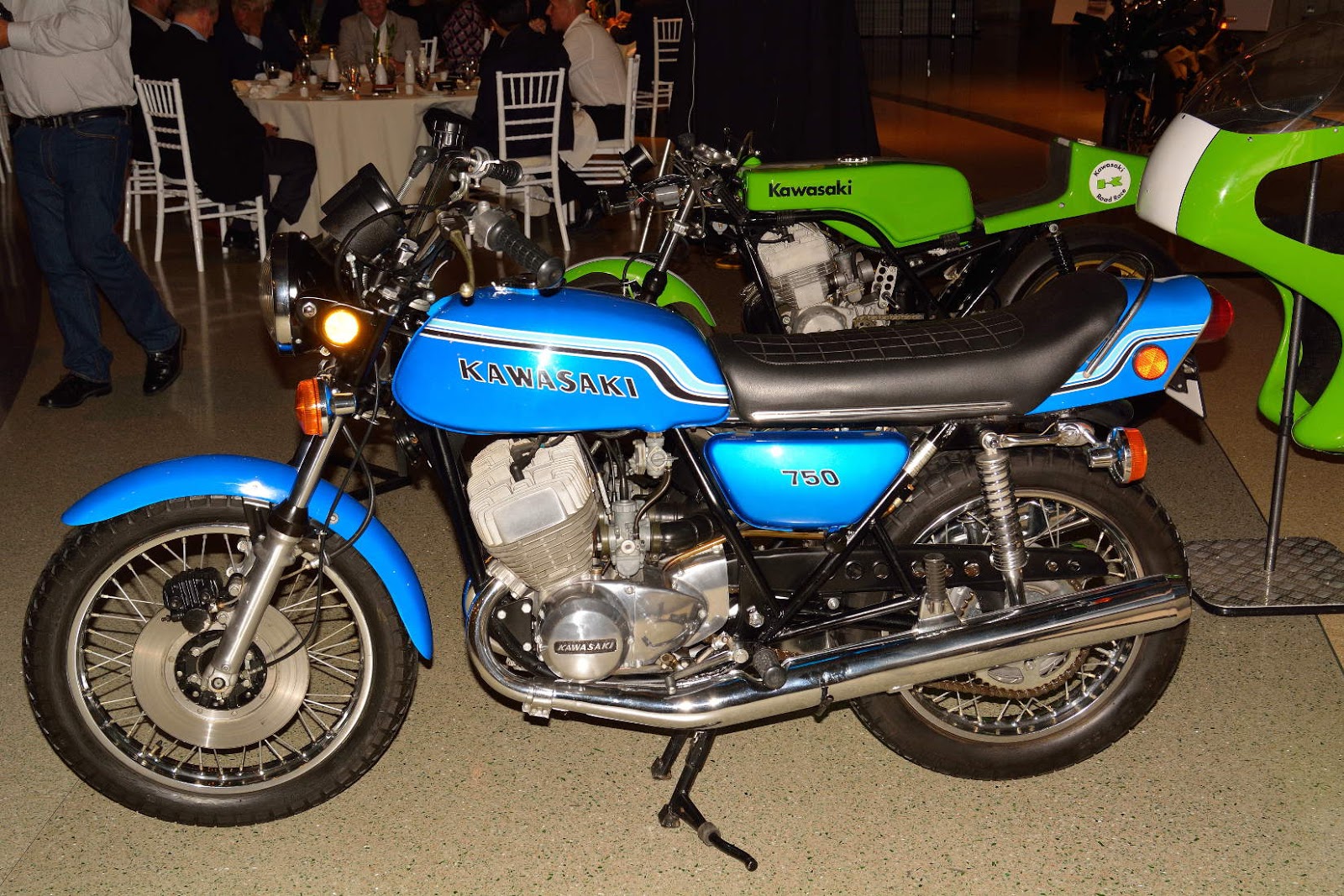
Kawasaki H2 750 Front look

                           Chassis performance was less impressive, as the triple’s blend of power, light weight and barely adequate frame and suspension could provoke what one report described as a 'deadly wobble’. Owners were well advised to supplement the standard friction steering damper with an optional hydraulic damper, for which a frame lug was provided. At least the single front disc brake was reasonably powerful, although many riders boosted the system by fitting an optional second disc.
Original Triple: the H1 500
Kawasaki H2 750 Wikipedia

                             Kawasaki's first mean and nasty two-stroke was the 500cc H1, also known as the Mach III, which was introduced in 1969 and did much to establish the firm's reputation for performance. The triple produced 60bhp at 7500rpm, was good for over 115mph (185km/h) and was a match for anything on wheels away from the line due to its spectacular power-to-weight ratio. It combined the H2's dubious handling and poor fuel economy with a narrow power band that made it even more demanding to ride. New Zealander Ginger Molloy rode the racing derivative, the H1R, to second place in the 500cc world championship in 1970.

Kawasaki H2 750 Specification

                                      Conventional styling and a broad dual seat with grab-rail did not hide the fact that this was a scary bike by early 1970s standards. The single front brake disc gave reasonable stopping but twin-disc conversion was a popular modification. So was swapping the standard exhaust system for a set of expansion chambers, for extra power, noise and possibly holed pistons.

Kawasaki H2 750 Review

                                     Plenty of riders were happy to accept the triple’s handling and thirst because it was competitively priced and, most of all, so fast. ‘The Mach IV rates as the ultimate stud bike now available in terms of raw power and sheer speed,’ concluded American magazine Cycle World. ‘If being the fastest on your block appeals to you, so will the Mach IV!’ Although tightening emissions legislation meant that the triple was first detuned, then dropped, it would not be forgotten.

                     Kawasaki H2 750 Specification

  • Engine Air-cooled two-stroke triple
  • Capacity 748cc (71 x 63mm)
  • Maximum power 74bhp @ 6800rpm
  • Transmission Five-speed, chain final drive
  • Frame Steel twin downtube
  • Suspension Telescopic front; twin shocks rear
  • Brakes Disc front; drum rear
  • Weight 454lb (206kg)
  • Top speed 120mph (193km/h)

Friday, 17 February 2017

Kawasaki Z1 (1973) Specification, Wikipedia, On road Price

                                Kawasaki Z1


Kawasaki Z1 (1973) Price, Specs, Review, Top speed, Wikipedia, Color

                                   As well as being by far the world's most powerful production motorcycle, the Z1 was a handsome machine that screamed power and speed despite its high handlebars and a thick dual seat. This 1974-model Zl-A differs from the previous year’s original Z1 in its paint scheme and alloy, instead of black, engine finish.

Kawasaki Z1 (1973) HD Pics

                                   They called it the King, and in the mid- 1970s there was no disputing that Kawasaki’s Z1 ruled the roads. When the 903cc four was launched in 1973, its top speed of over 130mph (210km/h) put the new bike lOmph (16km/h) ahead of Honda’s CB750, its closest challenger. The Kawasaki was also more than a second quicker through the standing quarter mile, and just happened to be good-looking and very reliable too. No wonder it was an instant smash hit.

Kawasaki Z1 (1973) HD Images

                                     The Z1 ’s early story is one of triumph over near disaster. Kawasaki originally intended to build a 750cc four, and was close to completing work on the project, codenamed New York Steak, when Honda unveiled the CB750. Once the initial disappointment had faded. Kawasaki’s engineers realized that they now had the advantage of knowing what they had to beat. They enlarged their own engine to 903cc, and returned four years later to do just that.

Kawasaki Z1 (1973) HD Wallpaper


                                There was never any doubt that the Z1 engine, which featured twin overhead cams, working eight valves via bucket-and-shim adjustment, would have a substantial advantage over the smaller, sohc CB750 unit, which had changed little in the meantime.

Kawasaki Z1 (1973) HD Photos

                                  With a maximum output of 82bhp at 8500rpm, the Kawasaki motor was 15bhp more powerful, and produced considerably more low-rev torque too. It sat near vertically in a twin-downtube frame whose forks held a 19-inch wheel and single disc brake.

Kawasaki Z1 (1973) Exhaust Sound

                                       If the Zl’s chassis specification was nothing out of the ordinary, its styling gained some extra advantage. Although the Kawasaki was undeniably big and heavy, weighing 5421b (246kg) with fuel, it was very well proportioned. Its curved fuel tank, small sidepanels and rear duck-tail behind the dual seat gave a stylish, vibrant look that was totally in keeping with its performance.

Kawasaki Z1 (1973) Front look

                                    Not that the riders of any other bike got to see more than the back of the fast-disappearing Zl on the road. Its acceleration was brutal by contemporary standards, with the big twin-cam motor churning out smooth, strong torque throughout its rev range. There was plenty of scope to make it faster still, too, as many tuners and racers soon confirmed.

Kawasaki Z1 (1973) Tail Look

                                  Handling was a different matter. In normal use the Zl gave no problem, and was even fairly comfortable despite its high handlebars. Pushed harder, the awesome motor was sometimes too much for the chassis, causing high-speed instability. Many owners fitted steering dampers and aftermarket rear shocks, which helped. Better still was a frame kit from a specialist such as Harris, Martin, Egli or Bakker.

Kawasaki Z1 (1973) Wikipedia

                                       Most owners found the Zl plenty good enough as it was. Such was its performance lead that Kawasaki’s only changes for the first two years were cosmetics and minor details. In 1976 a second front disc brake, previously an optional extra, became standard fitment, while smaller carbs and more restrictive pipes (to reduce emissions for the US market) reduced peak power slightly. The bike also gained a new name, becoming the Z900. One other thing didn’t change: its status as the two­wheeled King of the road.

Kawasaki Z1 (1973) Specification

A Faster Four - The Z1-R

Kawasaki Z1 (1973) Review

                                  Kawasaki's answer to increased challenges from rival Japanese *ours m 19^8 was the Z1-R, an uprated version of the current Z1000. The most ob.ious change .vas the bikini fairing, whose angular lines were echoed in the fuel tan< and bodywork. The standard 1015cc engine remained, but bigger carbs a^d a *our- into-one pipe increased output by 6bhp to 90bhp. Chassis updates nclucec a braced frame, retuned suspension, cast wheels and revamped brakes. Top soeeo was increased to 130mph (209km/h), and the fairing boosted high-speec comfort, though not stability. Handling at lower speeds was marginally bette' too. Overall this was the best big Kawasaki yet.

                         Specification Kawasaki Z1                                                      (1973)


  • Engine Air-cooled dohc eight-valve four
  • Capacity 903cc (66 x 66mm)
  • Maximum power 82bhp @ 8500rpm
  • Transmission Five-speed, chain final drive
  • Frame Steel twin downtube
  • Suspension Telescopic front; twin shocks rear
  • Brakes Single disc front; drum rear
  • Weight 542lb (246kg) wet
  • Top speed 132mph (212km/h)

Tuesday, 14 February 2017

Kawasaki Z1300 (1979) Specification, Review, HD Photos

                         Kawasaki Z1300


Kawasaki Z1300 Price, Specs, Review, Top speed, Wikipedia, Color

                        Kawasaki made no attempt to disguise the size of the Z1300, whose oversized fuel tank and bodywork dwarf even the huge engine. There was also little visual attempt to highlight the six cylinder layout. The exhaust downpipes were partially obscured by the radiator, and there were only two silencers.

Kawasaki Z1300 HD Pics

                         The gigantic six-cylinder Zl 300 arrived in 1979 to mark the end of a decade that had seen great change in superbikes’ performance, size and technical specification. This I20bhp behemoth was not simply the world’s most powerful production motorcycle, it was fully I5bhp more potent than its closest challenger, Honda’s CBX1000, and also produced more power than many cars.

Kawasaki Z1300 HD Images

                         Ironically the Kawasaki was not the brutal performance machine that its vital statistics and enormous slab-sided bodywork suggested. The Z1300 was notable for its sophistication and smoothness, as much as for its horsepower. With its upright riding position, liquid cooling and shaft final drive, the big Six was less of an aggressive sports machine than a grand tourer, albeit one without the convenience of a fairing.

Kawasaki Z1300 HD Wallpaper

Fast and torquey

                                    The Z1300 was mighty fast for all that, with a top speed of almost 140mph (225km/h) despite the aerodynamics of a small building. Although it weighed over 670lb (304kg) with fuel, it was awesomely quick off the line, matching even the best rival four-cylinder rivals. And the Kawasaki had superbly strong mid-range power delivery too, giving instant throttle response that made the big bike effortless to ride.

Kawasaki Z1300 HD Photos

                                   That performance came from a 1286cc motor that was conventional in its dohc, two-valves-per- cylinder top-end layout, if in nothing else. Liquid cooling allowed the cylinders to be spaced more closely together than with an air-cooled design. Long-stroke dimensions of 62 x 71mm also helped keep the motor reasonably narrow, despite its alternator’s location on the end of the crankshaft. Like the engine, the chassis owed much to Kawasaki's previous fours. The twin-cradle frame’s steel tubes were thicker than normal, and held strong 4lmm leading-axle forks. Simple twin shocks took care of suspension at the rear. Wheels and tyres were broad, in an attempt to control all that power and weight.

Kawasaki Z1300 Exhaust Sound

                                   Considering the Kawasaki’s size, it handled surprisingly well. The combination of strong frame and competent suspension made the Z1300 much less of a handful than it might have been, giving a reassuringly stable feel even at high speed. The big bike even felt respectably agile in tighter bends, and its triple-disc brake system worked well.

Kawasaki Z1300 Front look

                                   Even so, the Z1300 failed to sell in large numbers. That was partly because it was much more expensive than rival fours, but ultimately no faster, more practical or more exciting to ride. The bike was capable of cruising at lOOmph (I6lkm/h) indefinitely, but its high handlebars and forward-set footpegs meant its rider was not, at least not for long. Throttle response was slightly snatchy and, although the Six was smooth, it had a busy feel that did not make for relaxed cruising.

Kawasaki Z1300 Tail Look

                                     The Zl300’s arrival highlighted Japanese manufacturers’ fixation with ever greater power, weight and complexity, but Kawasaki’s timing was not good. In the midst of an oil crisis, the West German government had recently introduced a lOObhp power limit. Thoughts were turning towards economy and efficiency. Words such as ‘overkill’ were commonly used in road tests, some of which claimed the Z1300 would lead to bikes being banned.

Kawasaki Z1300 Wikipedia

                                    That did not happen, but the Z1300 proved a turning point because, from then on, manufacturers aimed to improve performance through increased engine, aerodynamic and chassis efficiency, rather than simply raw power and size. The mights Z1300 gained a certain cult status though, and remained in production, with very few changes, right up until 1989 - serving as a rolling reminder of 1970s' superbike excess.

Kawasaki Z1300 Specification


                                   Handling was good, given the limitations of the Kawasaki’s size. Suspension was reasonably firm, the tubular steel frame was rigid, and the bike even had a respectable amount of ground clearance. At slower speeds, the Z 1300's long wheelbase helped make for relatively easy manoeuvring, despite the bike’s weight and tall seat.


Kawasaki Z1300 Review

                                    The headlamp’s angular shape was echoed in other features including indicators and instrument console. With so much power on tap, aerodynamics were not a consideration.

Kawasaki Z1300 On Race Track

                                   At close to 3001b (136kg) even without its drive shaft, the Z1300’s liquid-cooled engine alone weighed more than some complete bikes. The 1286cc six-cylinder 120bhp motor was motorcycling’s most powerful by 15bhp.


                  Specification Kawasaki Z1300                                                  (1979)


  • Engine Liquid-cooled dohc 12-valve six
  • Capacity 1286cc (62 x 71mm)
  • Maximum power 120bhp @ 8000rpm
  • Transmission Five-speed, shaft final drive
  • Frame Steel twin cradle
  • Suspension Telescopic front; twin shocks rear
  • Brakes Twin discs front; disc rear
  • Weight 672lb (305kg) wet
  • Top speed 135mph (217km/h)

Kawasaki GPz1100 (1981) Weight, Color, HD Wallpapers

                        Kawasaki GPz1100

Kawasaki GPz1100 Price, Specs, Review, Top speed, Wikipedia, Color


                      The angular instrument console included a fuel gauge, but most GPz riders were more interested in the big 


Kawasaki GPz1100 HD Pics

                           Bright red paintwork plus black finished engine and pipes gave the big GPz a suitably striking appearance.

Kawasaki GPz1100 HD Images

                             With its bright red paintwork, fancy new | initials and high-tech fuel-injection system, the original GPzl 100 was the biggest and fastest of a new three-bike range of high-performance fours that brought Kawasaki storming into the 1980s. But once glance confirmed that the big GPz was very much a superbike of the old school, with an air-cooled, two-valves-per-cylinder engine, twin-shock chassis and generous supplies of both power and weight. Even at a standstill, the GPz was an imposing motorcycle. Its angular styling made no attempt to hide the fact that this bike was not built to be messed with. Its seat was high, its wheelbase was a long, and it weighed a substantial 562lb (255kg) with fuel. The engine's capacity of I089cc was slightly smaller than that of Yamaha's rival XSl 100. let alone Kawasaki's own Z1300 six. But with a peak output of l()8bhp at 8500rpm. the GPz was the world’s most powerful four in 1981. 

 Kawasaki GPz1100 HD Wallpaper

                               Kawasaki needed that credibility boost, because the Big K's reputation for all-conquering performance had slipped since the mid-1970sheyday of the Zl and Z900. Unlike its rival the 16- valve Suzuki GSX1100, the GPz relied on Kawasaki’s age-old format of two valves per cylinder. But the new motor was substantially uprated from that of the Z1000H EFI, which had become the world's first fuel-injected roadster 12 months earlier.

Kawasaki GPz1100 HD Photos

                            Capacity was increased by boring out the cylinders to give dimensions of 72.5 x 66mm, and the larger pistons had higher domed crowns to increase compression ratio. The new motor had bigger valves and revised timing for its twin cams, the crankshaft was lightened, the five-speed gearbox strengthened and an oil-cooler added between the frame’s twin downtubes.

Kawasaki GPz1100 Exhaust Sound
Uprated chassis

                               The GPz’s chassis was also based on that of the 1000H, with numerous modifications. Its main frame tubes were made from larger-diameter but thinner-walled steel. Rake and trail dimensions were increased. Front forks were 38mm in diameter and air-assisted. Rear shocks could be tuned for rebound damping as well as the normal preload. All this was state-of-the-art for a Japanese superbike.\

Kawasaki GPz1100 Front look
Add caption

                            So too was the bike's large instrument console, with its voltmeter and fuel gauge set between the speedometer and rev-counter.

Kawasaki GPz1100 Tail Look

                                 Those dials got to record plenty of action. With its big valves and hot cams the GPz liked to be revved, tugging hard on its rider’s arms as it howled through the gears towards the 8500rpm redline and a top speed of around 140mph (225km/h). Acceleration away from the line was ferocious, making the GPz motorcycling's straight- line king in 1981. And its mid-range delivery was excellent, too. The fuel-injection gave a crisp response, sending the bike surging forward even from below 3000rpm in top gear.

Kawasaki GPz1100 Wikipedia

                                Stability at speed was good provided the GPz was pointed in a straight line and the throttle was held open. Competent suspension meant that the big bike could be good fun in corners, too. But braking and changing direction at the same time was more than the chassis could take without complaint. The GPz was slightly lighter than its Z1000H predecessor but there was still a lot of metal to throw around.

Kawasaki GPz1100 Specification

                                       Kawasaki moved quickly to update the GPz, adding a handlebar fairing in 1982. and a year later revising it further with a larger, solid-mounted fairing plus single-shock rear suspension. In 1984 came a bigger step: the liquid-cooled, 16-valve GPZ900R. That was the bike with which Kawasaki entered the modern era. but its debt to its predecessor of 1981 should not be overlooked. For it was the first big red GPz 1100 four that restored Kawasaki’s justifiably proud reputation for full- blooded high performance.

Kawasaki GPz1100 Review

                               This 1981 model GPz was the last of Kawasaki’s flagships to rely on the traditional naked layout. Just a year later the hike was given a handlebar fairing that made its mighty four-cylinder engine's performance more usable; and in 1983 the final air­cooled GPz. had a more substantial fairing.

Kawasaki GPz1100 Stunt Pics

                                         Handling was fine at a reasonably rapid pace. But when pushed harder the GPz.llOO was one of many big Japanese fours whose chassis sometimes struggled to control the bike’s power and weight. resulting in high-speed instability.


             Specification Kawasaki GPz1100                                                   (1981)


  • Engine Air-cooled dohc eight-valve four
  • Capacity 1089cc (72.5 x 66mm)
  • Maximum power 108bhp @ 8500rpm
  • Transmission Five-speed, chain final drive
  • Frame Steel twin downtube
  • Suspension Telescopic front; twin shocks rear
  • Brakes Twin discs front; disc rear
  • Weight 562lb (255kg) wet
  • Top speed 140mph (225km/h)

Saturday, 11 February 2017

Kawasaki GPZ900R (1984) Engine specification, Color, Weight


                         Kawasaki GPZ900R


Kawasaki GPZ900R Price, Specs, Review, Top speed, Wikipedia, Color

                       The Ninja’s aerodynamic full fairing and compact dimensions helped give the 908cc bike a top speed of over 150mph (241 km/h). The original bike’s 16-inch front wheel was changed to a wider 17- inch unit on later models.

Kawasaki GPZ900R HD Pics

                       The GPZ900R was the machine with which Kawasaki recaptured its reputation for unbeatable four-cylinder performance. When the firm’s first liquid-cooled four stormed onto the streets in 1984, the manner in which it delivered 150mph (241 km/h) top speed with smoothness and unprecedented refinement confirmed that a thrilling new era had begun.

Kawasaki GPZ900R HD Images

                               And there was much more than sheer speed to the bike that in most markets was known as the Ninja. This was a 9()8cc machine that felt as compact as a 750 - and which outran its 1 lOOcc rivals when you opened the throttle. Street riders took to it in droves, production racers adopted it as their own. Almost everyone who rode the Ninja was won over by a machine that combined speed with reliability, handling, comfort and its own unmistakable style.

Kawasaki GPZ900R HD Wallpaper

                          Kawasaki had spent the previous decade earning a reputation for brilliant air-cooled eight- valve motors, but the GPZ unit was distinctly different. As well as liquid-cooling, it featured a 16-valve cylinder head plus developments including a balancer shaft, camchain at the end of the crankshaft, and alternator above the six-speed gearbox. It was small, light and powerful, though its peak output of 113bhp at 9500rpm was slightly below that of the old GPzl 100.

Kawasaki GPZ900R HD Photos

                              The rest of the GPZ maintained the theme of high performance with minimum size and weight. Kawasaki called the bike’s frame layout a ‘diamond’ but essentially it was a steel spine design that used the engine as a stressed member, and which dispensed with the conventional downtubes. Aluminium was used for the square-section rear subframe, the box-section swingarm. and the large alloy footrest hangers on which it pivoted.

Kawasaki GPZ900R Exhaust Sound

                                Front forks were 38mm units incorporating an anti-dive system that increased compression damping with suspension travel. Rear suspension was by Kawasaki’s Uni-Trak monoshock layout, with an air-assisted shock unit that could be adjusted for rebound damping. The front wheel was 16 inches in diameter, following the fashion of the day.

Kawasaki GPZ900R Front look

Searing speed

                             The sharply styled full fairing did a reasonable job of shielding the rider, who leant forward to fairly flat handlebars. The Ninja was low, sleek - and most of all it was fast. Due to its superior aerodynamics it had a top-speed edge over its GPzl 100 predecessor, with dramatic acceleration above 6000rpm and searing speed from 8000rpm to the l(),5()0rpm redline.

Kawasaki GPZ900R Tail Look

                                  And the rest of the bike did not let it down. High-speed stability was exemplary, partly due to suspension that gave a superbly taut feel at the expense of some harshness at slower speeds. At over 500lb (227kg) the 900 was no lightweight, but by superbike standards it was very manageable, and its twin front disc brakes were hugely powerful.

Kawasaki GPZ900R Wikipedia

                               The Kawasaki was also practical, combining a generous fuel range with reasonable comfort plus neat details including luggage hooks and a strong pillion grab-rail.

Kawasaki GPZ900R Specification

                            The Ninja’s success when launched was predictable, but even Kawasaki must have been pleasantly surprised by its long life. The 900 outlasted its intended replacements, the GPZ1000RX and the ZX-IO, and even in 1990 was not replaced but merely updated. The front wheel grew from 16 to 17 inches in diameter; both wheels were widened to allow fitment of fatter tyres; forks were thickened to 4lmm; and front brake discs were enlarged to 300mm and treated to new four- piston calipers.

Kawasaki GPZ900R Review

                           As it remained in Kawasaki’s range during the 1990s. the once mighty Ninja came to be regarded as a budget-priced sports-tourer rather than a serious high-performance machine. But that should not diminish its reputation. What should be remembered is that in 1984 the GPZ900R was the undisputed king of the road. And that it started the dynast) of liquid-cooled. 16-valve Kawasaki fours that continues to this day.

Kawasaki GPZ900R Stunt Pics

                           Handling was superb by 1984 standards, thanks to a rigid steel frame, plus firm, anti-dive-equipped front forks and an efficient rising-rate monoshock rear suspension system.

Kawasaki GPZ900R All Colors

                             Kawasaki's first four- valves-per-cylinder engine was a suitably impressive successor to the firm’s mighty two-valve fours. The initial ‘GPz’logo was later amended to ‘GPZ’ to distinguish the liquid- cooled range.

Kawasaki GPZ900R Top Speed

                              The GPZ 900R was the world’s top super bike in 1984. Its roadgoing prowess was confirmed by victories in numerous production races, including the revived Production TT.


            Specification Kawasaki GPZ900R                                             (1984)


  • Engine Liquid-cooled dohc 16-valve four
  • Capacity 908cc (72.5 x 55mm)
  • Maximum power 113bhp @ 9500rpm
  • Transmission Six-speed, chain final drive
  • Frame Steel spine
  • Suspension Telescopic front; single shock rear
  • Brakes Twin discs front; disc rear
  • Weight 502lb (228kg)
  • Top speed 155mph (249km/h)