Friday, 17 February 2017

MV Agusta 750 Sport (1973) Top speed, Pics, Specification

                        MV Agusta 750 Sport

MV Agusta 750 Sport (1973) Price, Specs, Review, Top speed, Wikipedia, Color


                                     MV's potent four- cylinder engine, with its gear-driven twin overhead cams, owed much to the firm’s all-conquering grand prix race bikes.

                                   This Sport, built as Phil Read was winning MV’s 16th consecutive 500cc world championship in 1973, has the disc front brake introduced that xear.

                                      The 750 Sport with which MV Agusta iH announced its arrival as a manufacturer of Hi roadgoing superbikes was a long time coming, but it proved well worth the wait. The Sport, with its handsome lines, potent 743cc, dohc engine and impressive chassis specification, was stunning: a high performance roadster that was based on the Italian marque’s all-conquering 500cc factory racebikes.

MV Agusta 750 Sport HD Pics HD Images HD Wallpaper HD Photos

                                        When the Sport reached production in the early 1970s, the small firm from Gallarate, near Milan, was nearing the end of a remarkable era of racetrack domination. MV’s unbroken string of 500cc world titles stretched back to 1958, with riders including John Surtees, Mike Hailwood and Giacomo Agostini. For all this time the firm’s autocratic boss, Count Domenico Agusta, had refused to produce a roadgoing version of the four- cylinder ‘Gallarate fire engines’.

                                    Instead, MV production had concentrated on the small-capacity singles with which Domenico had entered the motorcycle business in 1945, when the Agusta aircraft company was looking for a new direction at the end of the Second World War. Although a stylish 500cc four called the R19 Turismo had generated plenty of interest when displayed at the Milan Show as early as 1950, it had not been produced. When MV did build a roadgoing four, it was an ugly 600cc, shaft-drive tourer that barely managed lOOmph (I6lkm/h) and sold in tiny numbers.

MV Agusta 750 Sport Exhaust Sound

Designed for speed

                                     The 750 Sport was dramatically different. This was an uncompromising sports machine. It had low handlebars, rearset footrests, bold red, white and blue paintwork, a humped race-style seat, a quartet of unfiltered Dell’Orto carburettors, and four shiny megaphone pipes. Its engine was based on that of the tourer, but bored out to 743cc, and tuned with higher compression plus larger exhaust valves.

                                   It also produced considerably more power, its peak of 65bhp at 7900rpm being I3bhp up on that of the 600. Like that bike and MV’s racers, the Sport used gear drive to its twin overhead cams. Its crankcases were sandcast, in aluminium rather than the racers’ magnesium. The competition motor had no generator, so a combined starter/dynamo was added beneath the engine and connected by two belts.
MV Agusta 750 Sport Front look Tail Look

                                       Frame design owed more to the 600 than to the racebikes, as the Sport had one instead of two top tubes. The Sport also surprised many people by retaining the 600’s shaft final drive system, reportedly because Count Domenico did not want the bike to be raced for fear that privateers would damage his factory team’s reputation. But the Sport was equipped with top-quality cycle parts, including Ceriani forks and twin shocks, and Borrani alloy wheel rims. Early models had a big four-leading-shoe Grimeca front drum brake; later versions had twin discs.

                                              For the few riders who could afford one, the Sport was a magnificent bike. Top speed was about ll5mph (I85km/h), rather than the factory’s optimistic claim of I40mph (225km/h), but that was fast enough. And the MV’s smooth acceleration, plus especially the aural treat of rustling motor and howling exhaust note, made every trip an event. Handling and braking were good, too, even if the heavy, shaft-drive Sport had nowhere near the agility or stability of MV’s racers. Some owners later fitted chain-drive conversions from former MV race team boss Arturo Magni, who set up in business near Gallarate.

                                           MV’s dominance of the grand prix circuits was eventually halted by the Japanese two-strokes in 1975. The firm quit racing, and its roadsters did not last much longer. Despite their high prices, neither the Sport nor the later America and Monza fours were financially viable. Their intricate, hand-built engines were very costly to assemble, and production numbers were very low. By the end of the 1970s, MV had abandoned motorcycles to concentrate on helicopter production.

                                  The Sport's race-style full fairing was available as a factory option, as were a half fairing and a perspex fly screen. The roadster’s red, white and blue paint scheme did not match that of the scarlet ‘Gallarate fire engine ’ grand prix bikes, but contributed to the MV’s racy look.

MV Agusta 750 Sport Wikipedia

                                     Despite its heavy drive-shaft assembly and a frame that was less rigid than that of the racers, the Sport handled reasonably well, especially when fitted with later Marzocchi shocks with remote damping fluid reservoirs, as is the case with this otherwise standard machine.


         Specification MV Agusta 750 Sport                                                 (1973)


  • Engine Air-cooled dohc eight-valve four
  • Capacity 743cc (65 x 56mm)
  • Maximum power 65bhp @ 7900rpm
  • Transmission Five-speed, shaft final drive
  • Frame Steel twin downtube
  • Suspension Telescopic front; twin shocks rear
  • Brakes Twin discs front; drum rear
  • Weight 506lb (230kg)
  • Top speed 115mph (185km/h)

Tuesday, 14 February 2017

MV Agusta Monza (1977) Top speed, Pics, Specification

                             MV Agusta Monza


MV Agusta Monza Price, Specs, Review, Top speed, Wikipedia, Color

                             MV’s handsome sand-cast dohc four was enlarged to 837cc for the Monza. High compression, hot cams, big Dell’Orto carbs and loud pipes boosted claimed maximum output to 85bhp.

MV Agusta Monza HD Pics

                               Red and silver paintwork, low handlebars and a suede-covered single seat gave a racy look. Owners faced a dilemma of whether to cover the engine with an optional fairing.

MV Agusta Monza HD Images

                                 In 1977 the MV Agusta marque was nearing the end of its era of greatness on road and racetrack. Phil Read had won the factory’s 17th consecutive 500cc world championship three years earlier, before the thundering Italian four-stroke had finally been outpaced by Japanese two-strokes. The Agusta firm’s financial problems were not helped by sales of its unprofitable roadgoing fours.

MV Agusta Monza HD Images

                                But MV had one final throw of the dice in the Monza, the fastest and most exotic superbike that the original Agusta firm would ever build. Essentially a hotted-up version of the 750S America, which had been introduced to the US market two years earlier, the Monza combined breathtaking, racetrack-inspired styling with stunning performance from a biggest yet 837cc four-cylinder engine.

MV Agusta Monza HD Wallpaper

                              In both style and spirit the Monza was very close to the America, itself a direct descendent of the 750 Sport with which MV had belatedly arrived on the superbike scene at the start of the decade.

MV Agusta Monza HD Photos

                                    Like the Sport, the America was powered by a bellowing four-cylinder engine whose dohc layout, but not its shaft final drive, was inspired by MV’s grand prix machines. The America was so named because it had been developed at the request of the firm’s US agent, and had been intended for sale exclusively in the States.

MV Agusta Monza Exhaust Sound

                                        As well as more angular styling plus a red and silver paint scheme inspired by the all-conquering racers, the America had a larger 790cc engine, smaller 26mm carbuettors (they were easier to keep balanced), left-foot gearchange, improved output of 75bhp, and top speed of over 130mph (210km/h). The America was heavy, its high-speed handling was not perfect and it was expensive. (Its $6000 price explained why far fewer were sold than the US importer had predicted.) But it was a hugely desirable motorbike.

MV Agusta Monza Front look
                                         The Monza was even better. Its engine was enlarged by a 2mm increase in bore, giving dimensions of 69 x 56mm and capacity of 837cc. Compression ratio was increased, a new Marelli distributor was fitted, and the camshafts were new. Reverting to the Sport’s larger 27mm Dell’Orto carburettors also helped increase claimed output to no less than 85bhp at 8750rpm.

MV Agusta Monza Tail Look

Meticulous preparation

                                       Monza performance was further boosted because the bikes were prepared by MV’s former race team mechanics led by chief engineer Arturo Magni (who by this time, realizing that MV was nearing the end, had also set up his own firm nearby, selling cast wheels and tuning parts). This meticulous preparation meant that a new Monza roared to over I40mph (225km/h), especially when fitted with a Magni exhaust with its four elegantly curved black silencers.

MV Agusta Monza Wikipedia

                                        Chassis changes were minimal, as the Monza combined MV’s familiar frame with the cast wheels and triple-disc Brembo brake system that had been an option on later Americas. One thing that had changed was the bike’s name, at least in Britain, where it had been called the Boxer until Ferrari (who had a car of that name) had objected. Whatever the name, few were built before MV ceased production in 1978. The Monza was a suitably glorious way to end the line.

MV Agusta Monza Specification

                                        MV’s big roadsters differed from the grand pri.x bikes in their fitment of a heavy, power-sapping shaft final drive system.

MV Agusta Monza Review

                                     The rear- threequarters view emphasizes the stylish curve of the free-breathing, black finished Magni exhaust system, essential for maximum power and noise.

MV Magni - Ultimate Agusta

MV Agusta Monza Stunt Pics

                                        In many enthusiasts' view the finest air-cooled MVs of all are those kitted out with parts from the firm run by former race team manager Arturo Magni and his son Giovanni. Magni's frame was a much more rigid twin- oop design, similar to those of MV's factory racers, and combined with a Magn chain drive conversion to give greatly improved handling. As well as the disc nctive exhaust system, other Magni parts included a 862cc cylinder and piston kit, plus numerous chassis and bodywork components


              Specification MV Agusta Monza                                                (1977)


  • Engine Air-cooled dohc eight-valve four
  • Capacity 837cc (69 x 56mm)
  • Maximum power 85bhp @ 8750rpm
  • Transmission Five-speed, shaft final drive
  • Frame Steel twin downtube
  • Suspension Telescopic front; twin shocks rear
  • Brakes Twin discs front; disc rear
  • Weight 529lb (240kg)
  • Top speed 145mph (233km/h)

Tuesday, 31 January 2017

MV Agusta 750 F4 (1999) Colors, Specification, Vintage collection


                         MV Agusta 750 F4


MV Agusta 750 F4 Price,Specs, Review, Top speed, Wikipedia,Colors

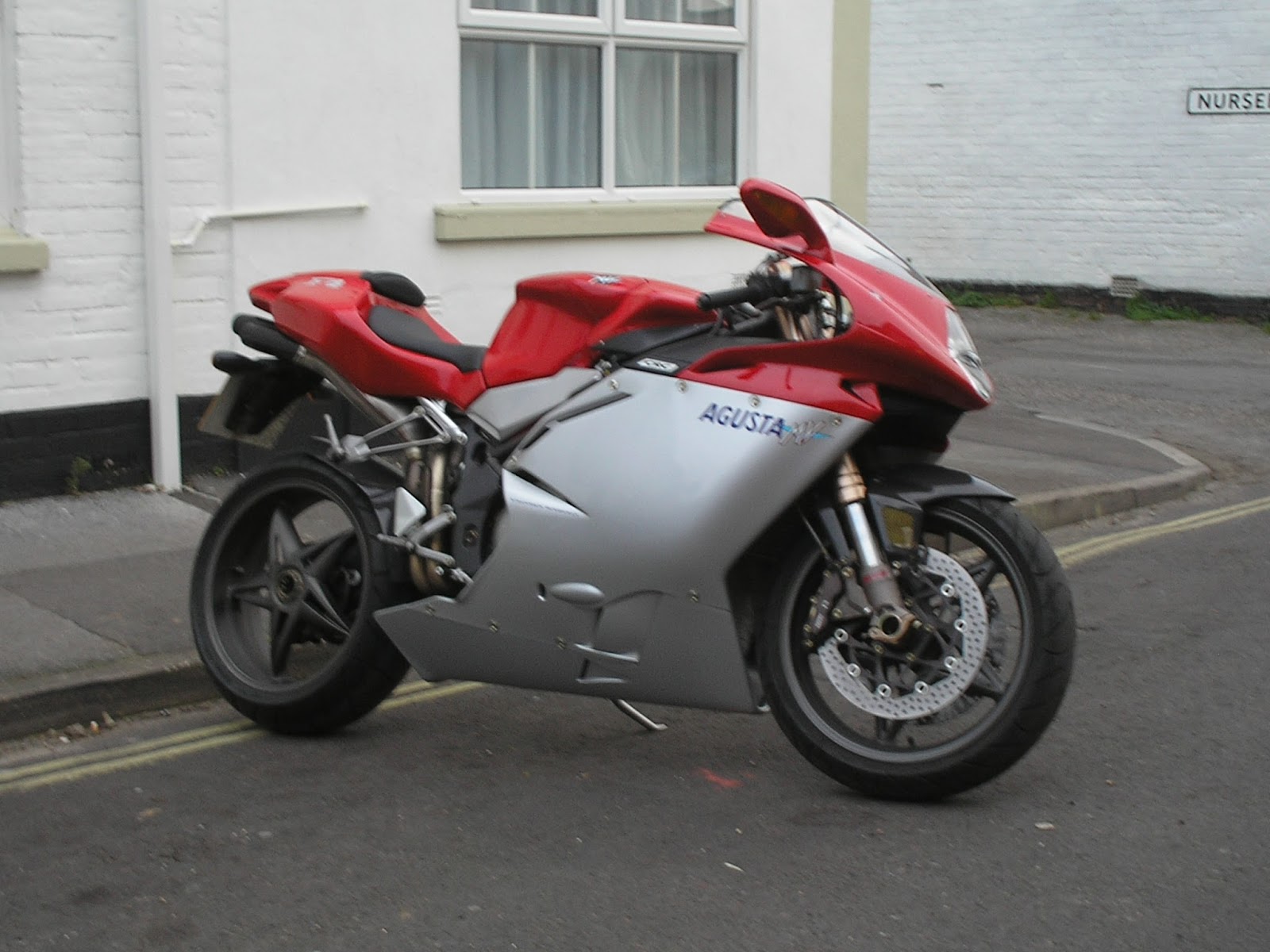
                 The F4Is quartet <>' high-level silencers gave a unique rear view. Exhaust and intake notes were tuned for rider enjoyment as well as performance.

MV Agusta 750 F4 HD Pics

               Indisputably one of the world’s most stylish superbikes, the F4 echoed the mighty MVs of the past with its red and silver paint scheme and Jour-cylinder engine layout.

MV Agusta 750 F4 HD Images

                       If ever there was a bike that epitomized the Italian love of glamour, speed and all things mechanical it was the 750 F4 with which MV Agusta was reborn in 1999. The F4 was gorgeous and brilliantly engineered, from the tiny twin headlights in its fairing’s nose all the way to the four cigar-shaped tailpipes that emerged from beneath its sculpted tailpiece. It had performance, handling, and a fascinating history. MV Agusta, one of the world’s most famous marques, was back - in style.

MV Agusta 750 F4 HD Wallpapers

                      The old MV firm from Gallarate, north of Milan, had won 17 consecutive 500cc world championships and built some of the world’s fastest and most exotic roadgoing superbikes before production ended in the early 1980s. The marque appeared dead until revived by Cagiva boss Claudio Castiglioni. After almost a decade of intermittent development, design genius Massimo Tamburini completed a bike to rank with the mighty Ducati 916, his previous creation.

MV Agusta 750 F4 Wikipedia

                        The F4's innovative chassis combined a ladder­like tubular steel main frame with cast swingarm pivots. On the limited-edition Serie Oro (Gold Series) F4, of which only 300 units were built, these cast parts were made from magnesium instead of the aluminium used for the mass-produced F4 S. The forks, especially developed by Japanese specialist Showa, were of an unprecedented 49mm diameter. The six-piston brake calipers were developed with Nissin: the tyres specially created by Pirelli. Tamburini's Cagiva Research Centre (CRC) designed the bodywork, which was made from lightweight carbon-fibre.

MV Agusta 750 F4 Front look

                   Ferrari engineers collaborated in the early design of the F4's 749cc engine, a liquid-cooled, 16-valve inline four that differed from Japanese rivals by having radial valves, which MV's engineers said gave better breathing. The F4 was also the only roadgoing bike to have a racebike- style removable ‘cassette’ gearbox. Tamburini designed the complex exhaust system after dismantling and studying the exhaust of Castiglioni's Ferrari F40.

MV Agusta 750 F4 Tail look

Glorious exhaust note

MV Agusta 750 F4 Exhaust sound

                      The fuel-injected motor's peak output was 126bhp, so the 750cc F4 did not match open-class superbikes for outright speed. But the bike revved to 13,300rpm, made an improbably glorious exhaust note, and was seriously fast. The four- cylinder unit was smooth and sophisticated, too.

MV Agusta 750 F4 Speedo meter

                    It pulled crisply at low revs, and its six-speed gearbox was slick. There was no great step to the power delivery, just a steady increase as the yellow-faced rev-counter’s needle swept round the dial and the F4 headed for its top speed of over 160mph (257km/h).

MV Agusta 750 F4 Top speed

                        Handling was superb. At 4061b (184kg) dry the Serie Oro was very light. Its short wheelbase and racy steering geometry combined with the top- quality frame and suspension to make the bike wonderfully agile yet also very stable. At high speed in a straight line the bike was unshakeable, yet it could also be snapped into slow turns with the lightest of pressure, and was easy to flick from side to side. The brakes were very powerful, too. needing just a gentle squeeze of the lever to make the bike stop w ith massive force.

MV Agusta 750 F4 Stunt pics

                        For all its stunning looks and innovative technolog . some cynics argued that the F4. even the ultra-expensive Serie Oro version, was no lighter or more powerful than Suzuki"s much cheaper GSX-R750. But to assess the F4 in such terms was to miss the point - this was a bike that was one of the most stylish and immaculately detailed ever built, as well as one that will be forever remembered as the machine with which one of the great marques n. For the all-new F4 to be so beautiful, so fast and very special was an achievement t long and glorious history M\ Ae o.

MV Agusta 750 F4 Ex-showroom price in india

                             MV Agusta's enviable reputation was forged by the marque's 38 grandprix championships, including 18 in the 500cc class, and by fire-breathing four- cylinder superbikes of the 1970s.

MV Agusta 750 F4 On road price in india

                   The first 300 F4s were in exotic Serie Oro specification, with magnesium swingarm, frame castings and wheels, where the mass-produced F4 S used aluminium.

MV Agusta 750 F4 Exhaust sound

                        Straight-line performance of the 749cc F4 could not quite match that of open-class sports machines, but the F4's stability and handling poise were exceptional.


    Specification MV Agusta 750 F4 Serie Oro                                          (1999)


  • Engine Liquid-cooled dohc 16-valve four
  • Capacity 749cc (73.8 x 43.8mm)
  • Maximum power 126bhp @ 12,500rpm
  • Transmission Six-speed, chain final drive
  • Frame Tubular steel and cast magnesium
  • Suspension Telescopic front; single shock rear
  • Brakes Twin discs front; disc rear
  • Weight 406lb (184kg)
  • Top speed 165mph (266km/h)

Monday, 30 January 2017

MV Agusta Brutale (2001) Specification, Wikipedia, On road Price


                            MV Agusta Brutale


MV Agusta Brutale Price, Spec, Review, top speed, Color, Milage


                    Compact, barrel­chested, and eye-catching from its headlight to its tailpiece, the Brutale lived up to its name even at a standstill.

MV Agusta Brutale Specification

            MV Agusta’s dramatic rebirth with the 750 F4 sportster had been one of the great motorcycling stories of the 1990s. But the firm’s boss Claudio Castiglioni knew that, to make revitalised MV successful, he needed to create a range of bikes that would exploit the F4’s technology and image to the full. Enter the next stage in MV’s revival: the Brutale.

MV Agusta Brutale Wikipedia

                 The naked model shared the F4’s 749cc, liquid- cooled straight-four engine layout, with its radial four-valves-per-cylinder head design; and also the sports machine’s frame with its distinctive combination of cast sections and steel tubes. But one glance confirmed that there was a whole lot more to this bike than an F4 with its fairing removed.

MV Agusta Brutale HD pics

                 Like the F4, the Brutale was created by Massimo Tamburini, the former Bimota co-founder, creator of the Ducati 916 and godfather of modern motorcycle design. Despite its commonplace unfaired, straight-four layout, the MV resembled nothing else on two wheels. It was unique from its drooping headlight to its pair of side-by-side silencers on the right.

MV Agusta Brutale  HD Images

                In typical Tamburini fashion, the Brutale was dripping with neat touches, such as its carbon-fibre rimmed instrument console, adjustable footrests and intricate single-sided swingarm. The view from the low rider’s seat was dominated by the tapered, slightly raised one-piece handlebar. The upright riding position gave the Brutale some of the aggressive feel of an old-style superbike racer. That feeling was reinforced by the bike’s spine-tingling sound: a mix of intake gulping, through vents in the front of the fuel tank, and burble from the shotgun silencers.

MV Agusta Brutale  HD Wallpapers

                   Detuned but still rewy Although the Brutale engine was mechanically very similar to that of the F4, it was detuned by those new intake and exhaust systems. The result was a slightly reduced maximum of 127bhp at 12.50()rpm. and a boost in low-rev performance. Even so, to unleash the Brutale's full performance its rider had to keep the revs above the 9000rpm mark at which the motor breathed deeper and howled louder as it headed for the 13,000rpm rev- limiter and a top speed of 155mph (249km/h).

MV Agusta Brutale Ex-showroom Price


               That power delivery made the MV hugely entertaining to ride although, with such an exposed riding position, fast cruising quickly became tiring.


MV Agusta Brutale  On Road Price in India


                       Handling was excellent, as was to be expected of a bike so closely related to the F4. The Brutale was light, and could be flicked about easily with its broad handlebars, yet was stable at speed. The F4- style six-piston Nissin front brake calipers gave powerful stopping, too. And at slower speeds in town, the bike’s riding position made it reasonably comfortable.

MV Agusta Brutale Exhaust voice

                        MV originally announced that the first 300 units of the Brutale would come in Serie Oro (Gold Series) specification, with magnesium frame castings, swingarm and wheels. But the MV Group’s financial problems delayed production of those hand-built bikes. Following the MV Agusta Group’s purchase by Malaysian car firm Proton in 2004, it was the cheaper standard model, with aluminium chassis castings, on which production efforts were concentrated. Either way, the owners of an MV Agusta Brutale enjoyed plenty of raw performance and naked Italian style.

MV Agusta Brutale Front Look

Refined Ride: the Brutale 1090RR

MV Agusta Brutale Tail Look

                         Such was the Brutale's impact that several of its styling features were copied by other manufacturers. MV followed the original model with the Brutale 910, then the even more powerful 1078RR, which produced 154bhp. In 2010, MV's parent company Harley-Davidson, which had bought the Italian marque two years earlier, changed direction with a pair of revamped Brutales, the 990R and 1090RR, which were designed to be more rider-friendly. The higher specification Brutale 1090RR, in particular, combined thrilling performance with impressive refinement. Despite their success, in August 2010 recession-hit Harley sold MV Agusta to a company led by long-time figurehead Claudio Castiglioni.

MV Agusta Brutale Specification

              This Brutale’s gold frame casting, wheels and swingarm signified that it was a Serie Oro bike that used magnesium instead of aluminium for those parts. This saved a little weight and added considerably to the price. The two Brutale models ’ engines and other parts were

MV Agusta Brutale Stunt Pics

                    MV detuned the 749cc four-cylinder motor slightly from its F4 specification, which combined with the crisp fuel-injection system to give very lively throttle response. The Brutale’s short wheelbase and light weight also contributed to its suitability for wheelies.


   Specification MV Agusta Brutale Serie Oro                                         (2001)
  • Engine Liquid-cooled dohc 16-valve four 
  • Capacity 749cc (73.8 x 43.8mm) 
  • Maximum power 127bhp @ 12,500rpm 
  • Transmission Six-speed, chain final drive 
  • Frame Tubular steel and cast magnesium 
  • Suspension Telescopic front; single shock rear 
  • Brakes Twin discs front; disc rear
  • Weight 395lb (179kg)
  • Top speed 155mph (249km/h)

Sunday, 29 January 2017

MV Agusta F4 1000S (2003) Specs, Price, Review, Top speed, Colors


                         MV Agusta F4 1000s

MV Agusta F4 1000S Specs, Price, Review, Top speed, Colors

                    Only the optional silver-and-blue paint scheme and minor graphic details differentiated the sleek F4 lOOOS from its F4 750 relation - until its rider opened the throttle to send the 998cc MV hurtling forward with notably added force. Chassis layout was almost unchanged, too, although minor steering geometry revisions gave the more powerful newcomer a little extra stability.

MV Agusta F4 1000S wikipedia

                      Ufa MV Agusta claimed an official top speed of I86.9mph (300.7km/h) for the F4 I lOOOS, a figure apparently recorded during homologation testing at the Nardo Speed Bowl in southern Italy. Whether that was a realistic real-world figure or not, there was no doubt that the lOOOS was one seriously rapid motorbike, as well as a very beautiful one.

MV Agusta F4 1000S HD pics

                     That was no surprise. After all, apart from its paintwork and graphics, the lOOOS looked almost identical to the F4 750 with which MV had made its dramatic return back in 1999. And beneath its gorgeously sculpted fairing was a bigger, 998cc four-cylinder engine that gave the reborn Italian marque an open-class contender for the first time.

MV Agusta F4 1000S HD Images

                      The new motor retained the 750cc unit’s radial 16-valve layout and used many of its castings, but almost 70 per cent of the internal components were new. Many parts were lighter as well as being stronger, to cope with the additional output. The bigmotor produced a claimed I66bhp at 11,750rpm, within a few horsepower of its main Japanese rivals.

MV Agusta F4 1000S HD wallpapers

                     Like its bodywork, the lOOOS’s chassis was essentially that of the 750. The frame combined chrome-molybdenum steel tubes with cast-aluminium sections around the pivot for the single-sided swingarm. This bike’s upside-down Marzocchi forks were 50mm in diameter, like those of the limited- edition 750 SPR. and were angled half a degree less steeply at 24.5 degrees. The dry-weight figure was 422lb (l92kg), respectably light but slightly heavier than the lightest of the Japanese opposition.

MV Agusta F4 1000S HD Photos

                   That didn't prevent the MV from being fiercely competitive. At low revs the engine was unexceptional, but once into its stride the 1000S was a stunningly powerful and free-revving motorbike. The bigger motor was in a different league to the 750 as it kicked hard from 6000rpm, accompanied by a soulful sound as the radial-valve motor revved with delicious enthusiasm and smoothness, heading towards its limit at close to 13,000rpm.

MV Agusta F4 1000S Front Look

                        Riders on a racetrack, in particular, also gained from its most innovative technical feature, its EBS or Engine Brake System, which delivered a small amount of fuel to one cylinder when the throttle was closed, preventing rear wheel lock-up under braking.

Sharp and stable

MV Agusta F4 1000S Front Look

                     Handling was predictably superb. In tighter turns the F4 needed slightly more input than the 750, due to its less racy steering geometry, which added some stability to cope with the extra engine performance. Firm, well-damped Marzocchi forks and Sachs rear shock contributed to the bike’s taut feel. And the familiar blend of conventionally mounted six-pot Nissin calipers and 310mm discs gave sharp and controllable stopping.

MV Agusta F4 1000S  Exhaust sound
                  It was predictable that the F4 1000S was a very rapid motorbike, but even some MV fans were pleasantly surprised when it fractionally outperformed all of its Japanese rivals in magazines’ initial back-to-back speed tests. And for all-round appeal, this most stylish and charismatic of superbikes was arguably the pick of the bunch.

MV Agusta F4 1000S  Ex-showroom price

                  It certainly had the speed, handling and refinement to give MV Agusta a serious open-class contender.

MV Agusta F4 1000S On road price in india

               The 998cc radial 16-valve engine was held in MV's traditional frame, which combined steel tubes and cast-aluminium sections.

MV Agusta F4 1000S white and silver color

                  To the surprise of even some MV enthusiasts, the 1000S proved to be a straight-line match for even the fastest Japanese superbikes.


Beauty with Refinement: the New Generation F4

                     The F4 1000S and its successors including the F4 RR 312 - named after its claimed 194mph (312km/h) top speed - earned a reputation for fearsome performance, but eventually MV's design started to show its age. For 2010 the Italian marque, now owned by Harley-Davidson, launched a revamped F4 designed for refinement as much as speed. Beneath its reshaped fairing was a 998cc, 186bhp engine that was smoother than the previous unit. 

MV Agusta F4 1000S limited edition

                   Revised ergonomics, reduced weight and reworked suspension made the F4 more rider-friendly. Its success encouraged Claudio Castiglioni, whose firm had bought MV from Harley- Davidson, to unveil a 675cc three-cylinder derivative, the F3, for launch in 2011.


            Specification MV Augusta F4 (2003)

  • Engine Liquid-cooled dohc radial 16-valve four
  • Capacity 998cc (76 x 55mm)
  • Maximum power 166bhp at 11,750rpm
  • Transmission Six-speed, chain final drive
  • Frame Tubular steel and cast aluminium
  • Suspension Telescopic front; single shock rear
  • Brakes Twin discs front; disc rear
  • Weight 422lb (192kg)
  • Top speed 185mph (298km/h)